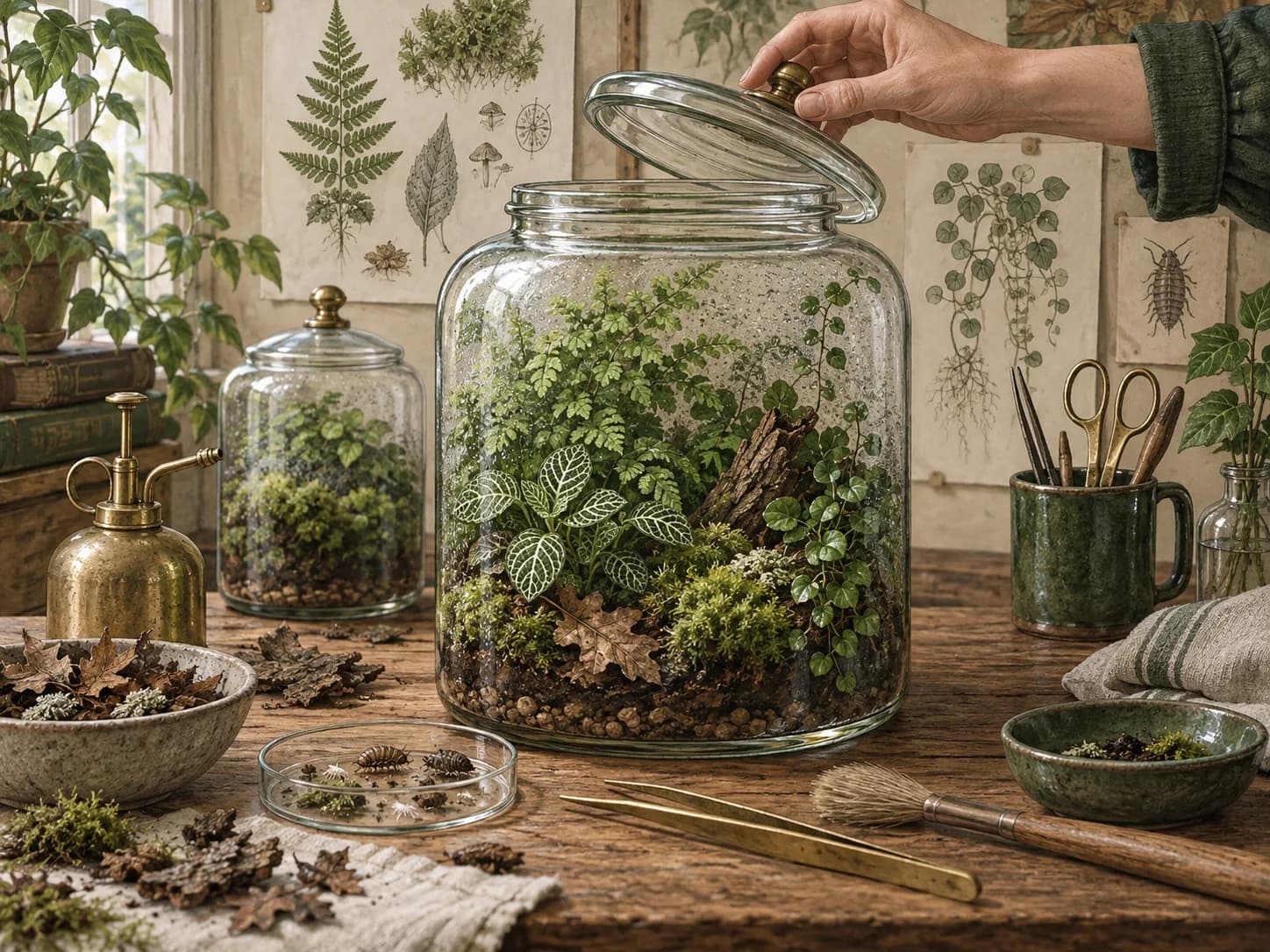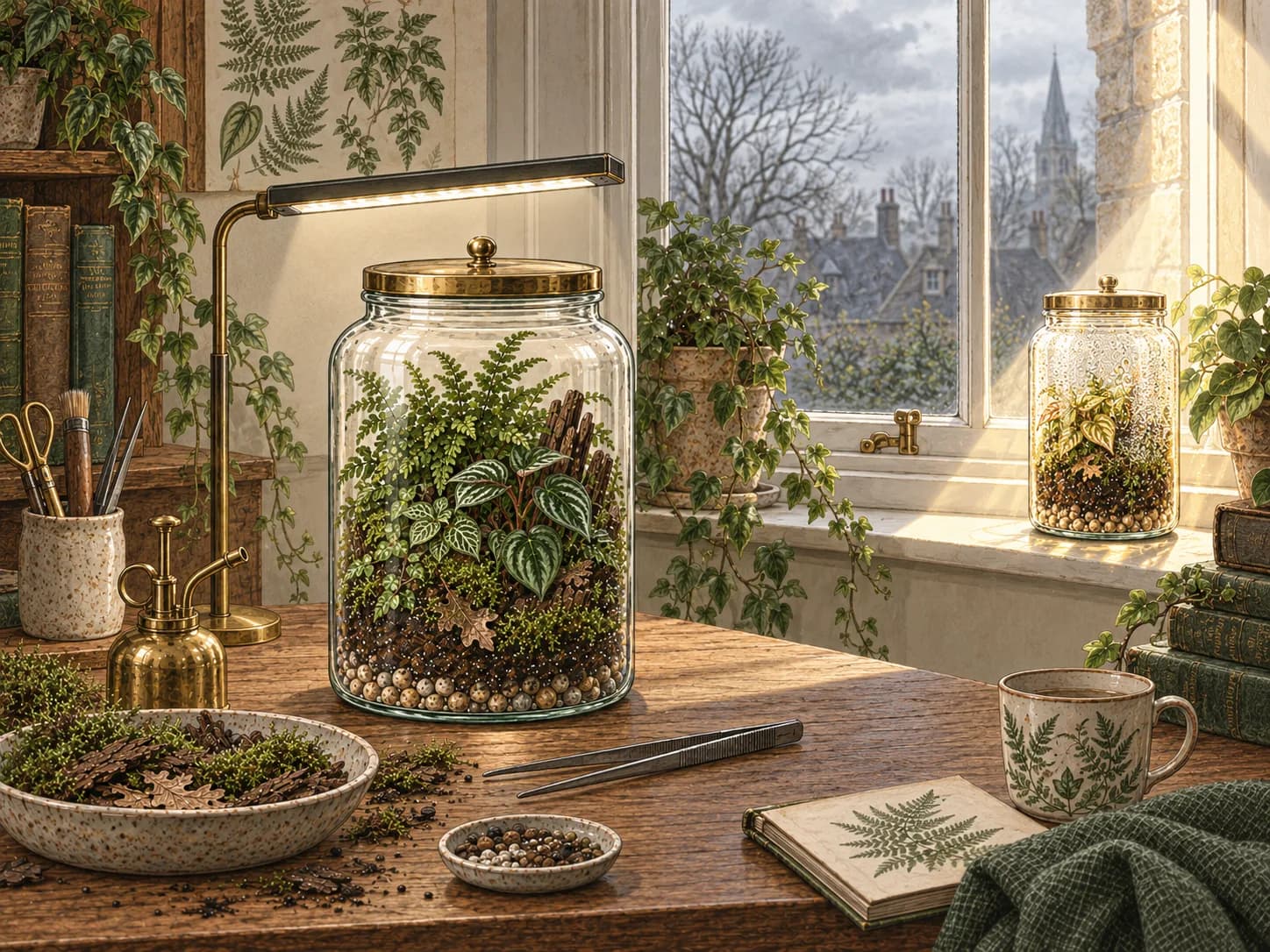
Lead with the glass, not numbers. A closed jar recycles water: leaves and mix give off vapour, it beads on cooler glass, and it runs back down. You are not watering a pot on a schedule. You are reading weather.
Think of a Kilner on a north windowsill in a British sitting room. In the morning the glass may look lightly misted. By lunch you can see Fittonia, moss, and the little round leaves of Pilea depressa again. That coming and going is the cycle doing its job.
Healthy weather
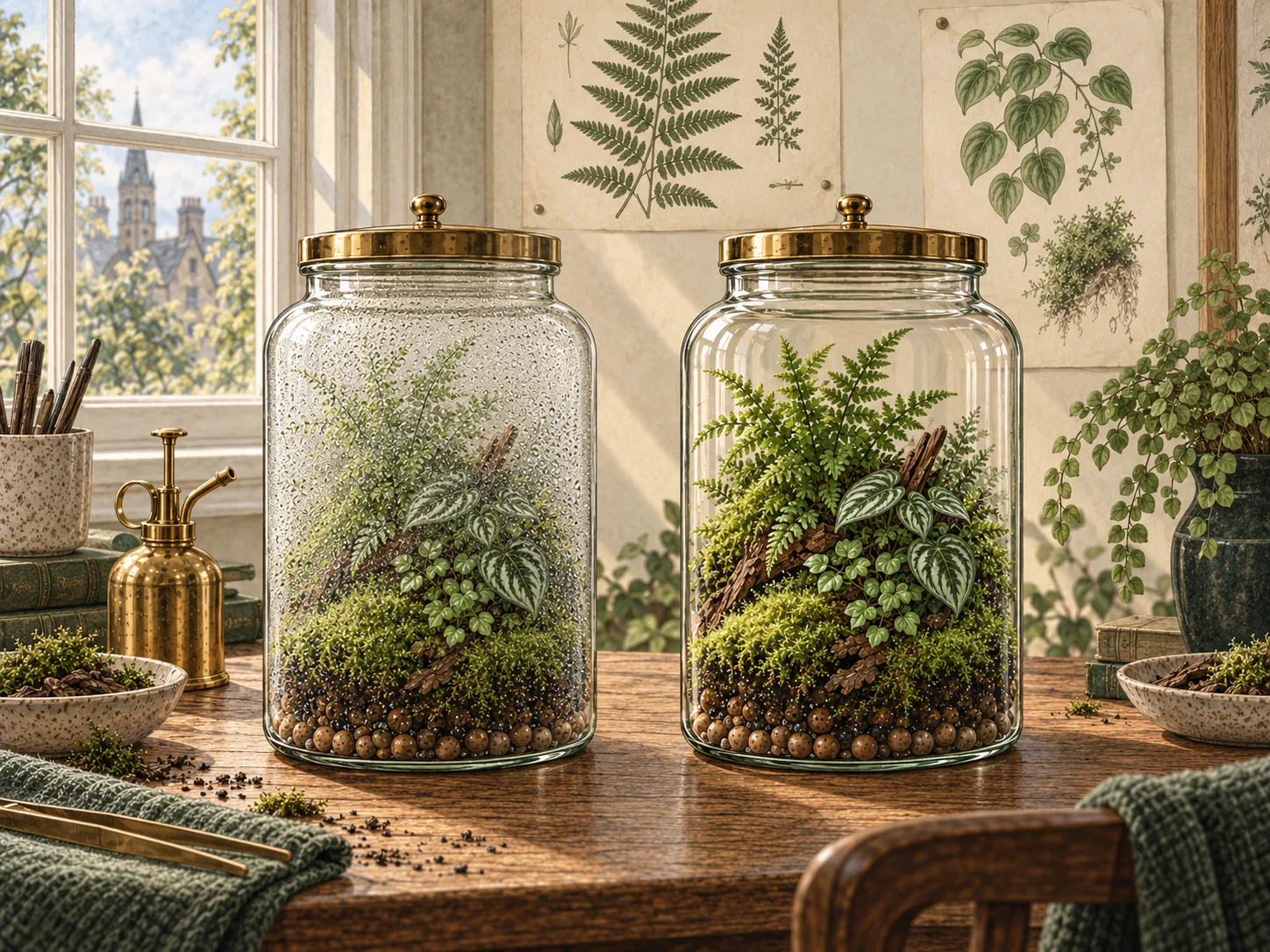
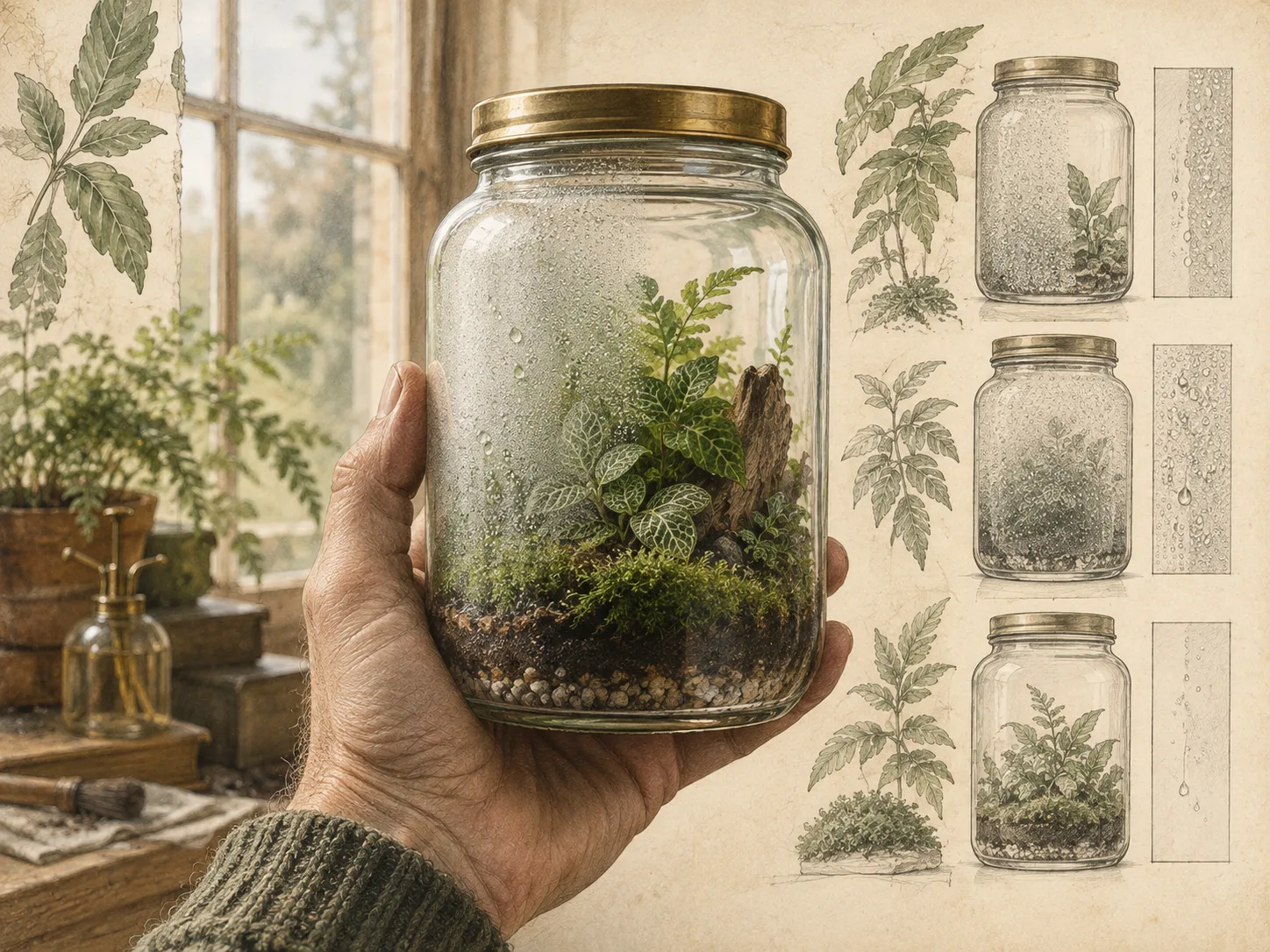
A thin film of condensation in the morning, or after a warmer spell, that clears later in the day is the usual sign the cycle is working. You should still be able to see the plants. The Closed Tropical Mix should feel like a wrung-out sponge — springy, not soup, not brick.
RHS advice for sealed bottle gardens is the same idea in fewer words: little water, a few times a year; light condensation means enough; too much means wipe or open the lid.
Do not teach the “lower-third only” rule as a law. Room temperature, jar shape, and where the case sits all change where mist sits. Treat patterns as diagnostics.
Four weather states to recognise (match the table):
Light mist that clears — leave it.
White all day — too much water, or a cold room holding fog. Vent.
Rain on warm glass — heat. Move the jar.
Clear for days, dry cues — a small sip, then wait.
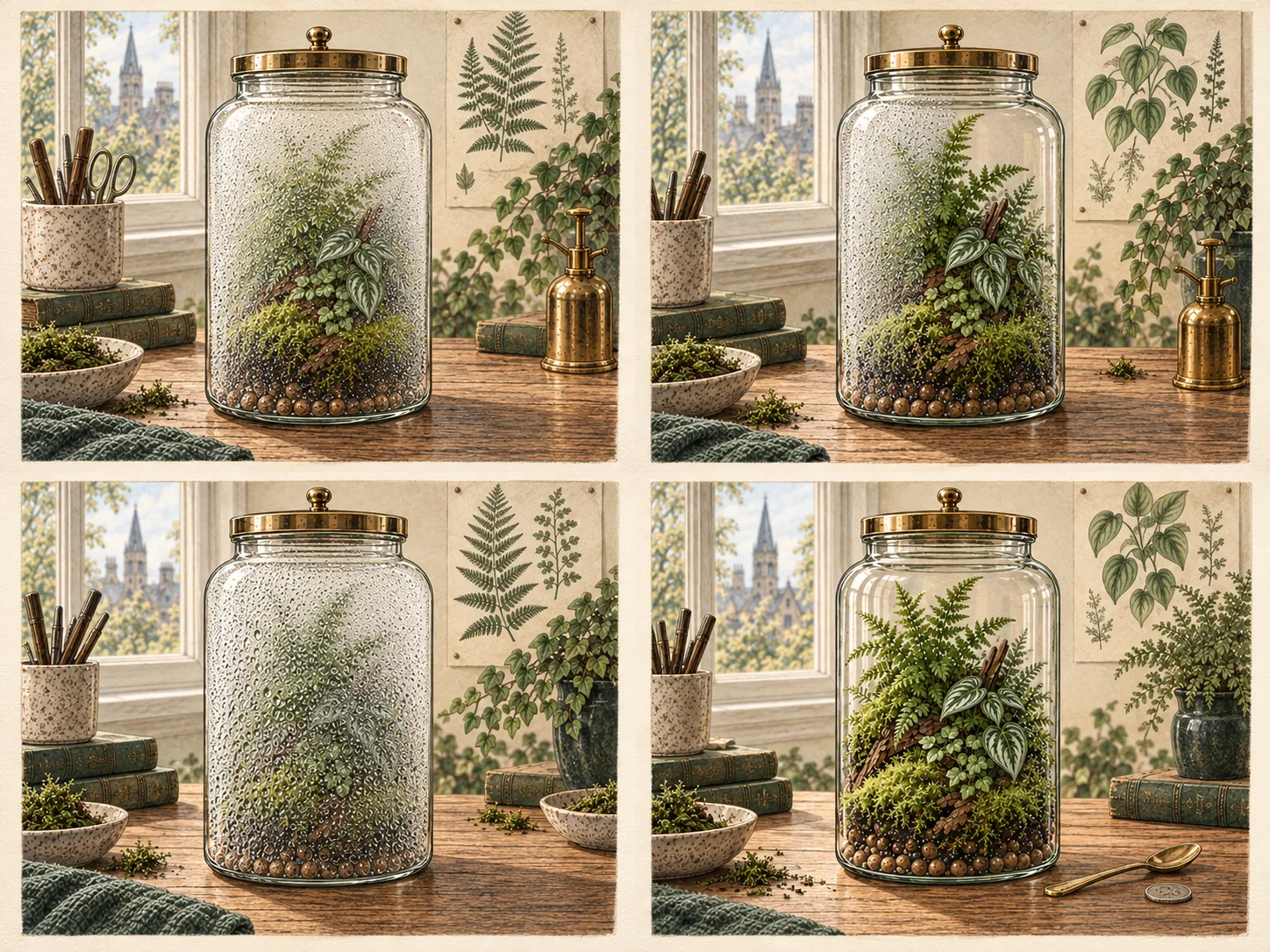
Confounders (why the glass lies)
Fog is not only “too much water.”
Heat: sun through glass, a radiator, a log burner, or a warm gadget underneath turns mist into rain and can cook tropicals in hours. UK south windows in summer are the usual culprit.
Place: bright shade — a north or east window, or set back from south or west — is the safer room.
Cold rooms: a chilly bedroom or a jar left between curtain and pane overnight can hold fog even when the mix is only damp. Vent a little; do not add water because the glass looks busy.
New builds: the first week often looks wetter than later weeks while moisture redistributes. Start slightly under-wet so you can add, not subtract. See cycling & venting.
One-sided mist: the cool face of the jar (window or outside wall) collects more beads. Rotate weekly. This is weather, not a flood, unless the mix is also wet.
Hard water: white crust on glass is mineral, not mould. Common in much of England. Wipe; prefer rain or filtered water for top-ups.
Lid gaps: bone-dry moss and clear glass with a “closed” jar often means the seal is leaking, not that you forgot a watering day.
Media (still)
A jar on a sunny south sill with rain-like droplets (heat confounder) next to the same jar a metre back in bright shade. Do not leave plants to cook for the shot — stage quickly or use a spare.
Media (still)
White mineral crust on inner glass, fingernail showing it scrapes off.
Hard water, not mould.
Media (clip)
8–12s: rotating the jar a quarter-turn on a windowsill.
One-sided mist follows the cool glass.
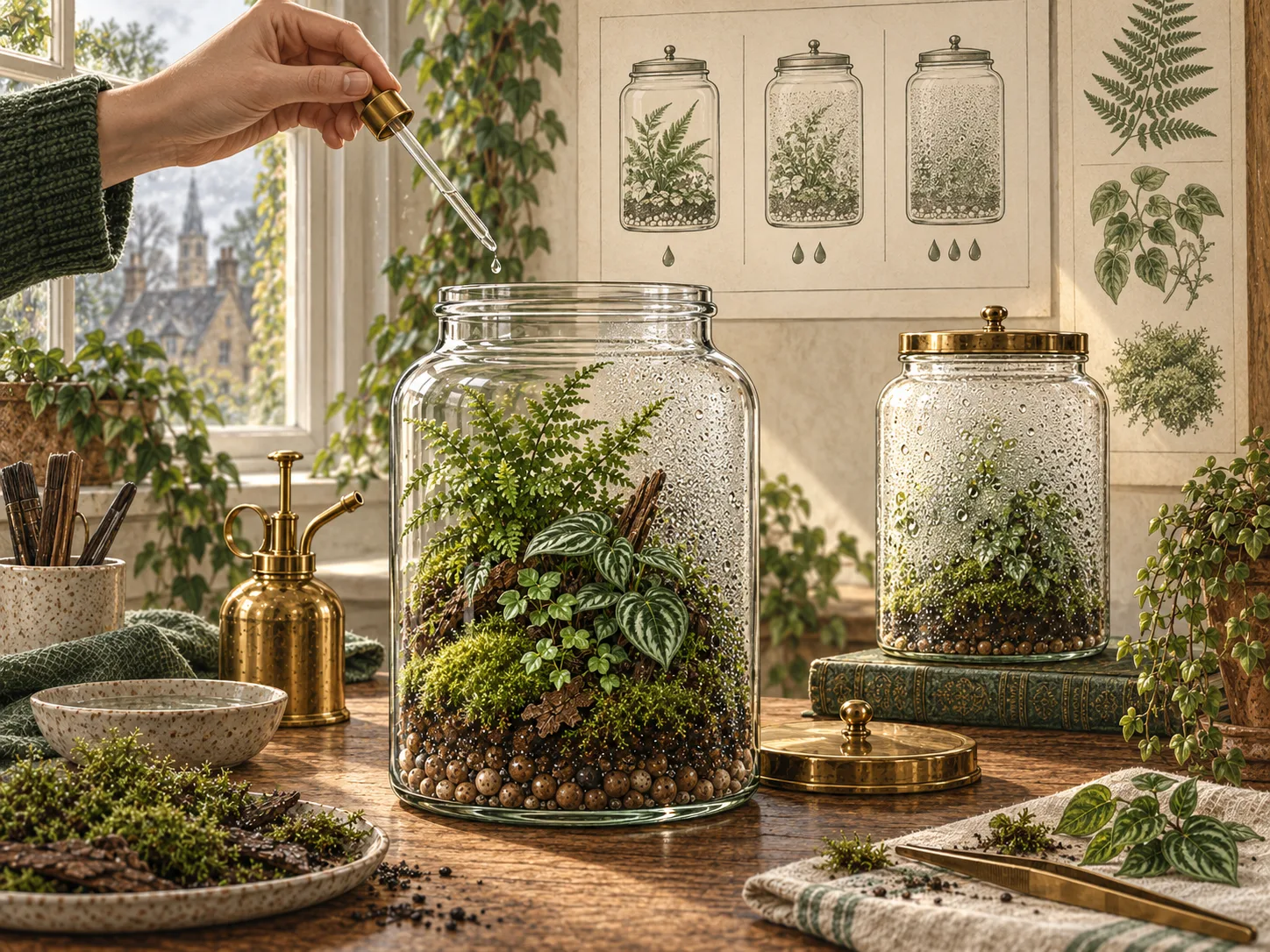
How to add water (pipette first)
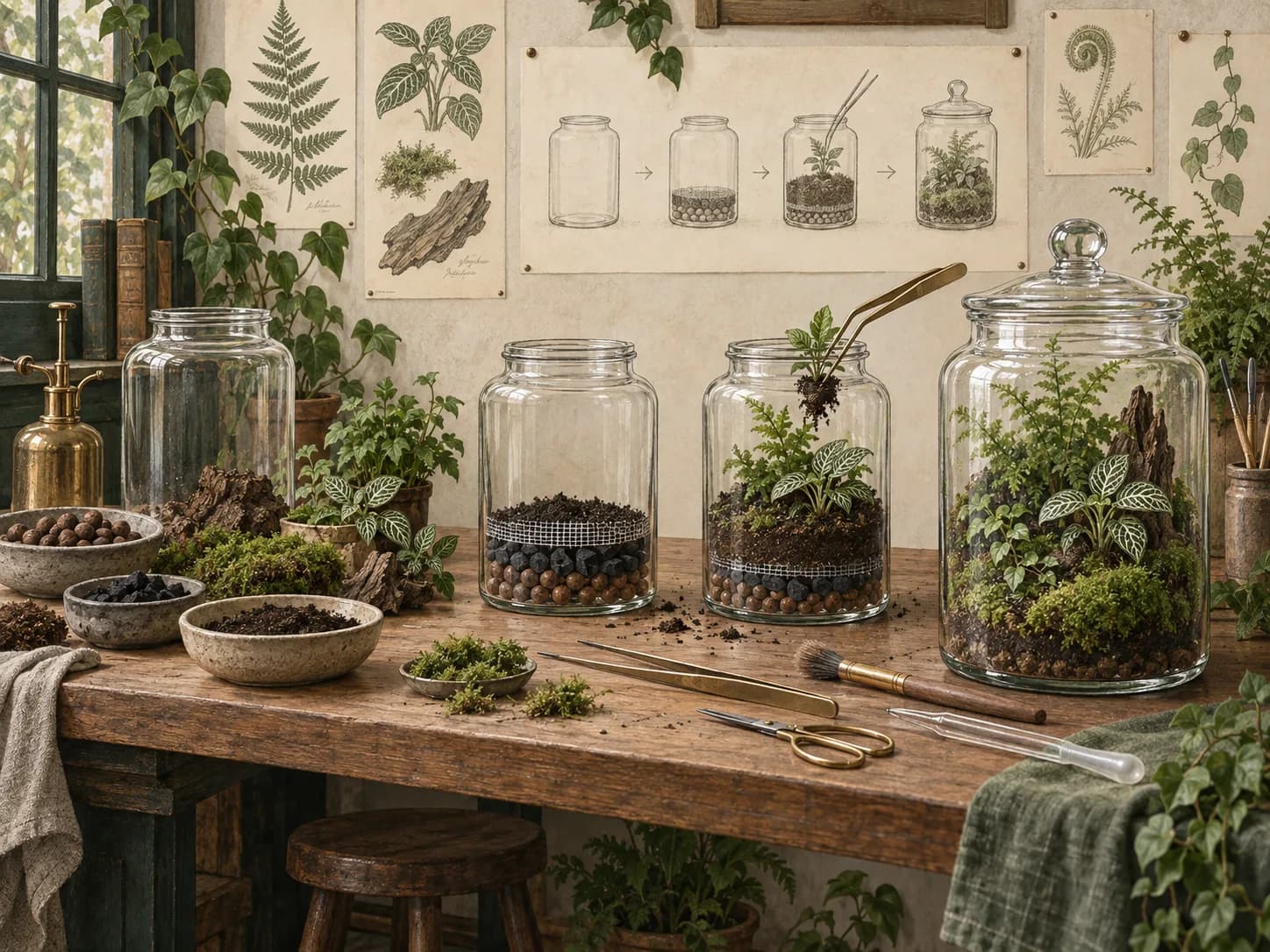
Tools: fine mister, pipette or syringe, kitchen paper, turkey baster for the false bottom. Mist for closed tropicals and moss; pipette when you need a sip at the roots without soaking the scene.
Decide you actually need water (clear glass plus dry cues — not nerves).
Open the lid briefly.
Aim at the mix around Fittonia and Pilea depressa roots, or a light film on moss — not a puddle on the surface.
Reseal.
Wait a day. Light condensation returning is enough. If nothing changes, another small sip.
Rain or filtered water is kinder than tap, especially for moss and for glass in hard-water postcodes. Never use leftover tea, plant feed, or fizzy water.
Restraint beats a schedule. A slightly dry sealed jar often recovers if you leave it; an overwatered jar needs work. Add slowly, then observe.
Media (still)
Tools laid out on a tea towel — pipette, fine mister, kitchen paper, turkey baster. No branded clutter.
Media (clip)
10–15s: lid off, pipette placing a few drops at Fittonia roots, then at Pilea depressa, not a spray-soak of the whole scene. End on resealing. Hands only; no voiceover required.
Media (still)
Mix squeezed in a palm — wrung-out sponge vs dripping mud vs dry crumble. Three small piles. Caption the three states.
How to take water away (vent, blot, siphon)
If the glass stays opaque, or droplets run all day, or you can see a reservoir:
Lid off for a few hours (sometimes most of a day). Wipe the inner glass.
Blot surface pools with kitchen paper.
Siphon the false bottom with a pipette or baster. Do not invert the jar.
Reseal when the mix is damp and you can see the plants. Watch a week. Light morning mist that clears is the aim.
Do not put the jar in a sunny window “to dry it.” Heat plus wet glass cooks Fittonia, moss, and Pilea depressa.
Media (clip)
12–20s: lid off, kitchen paper blotting a surface pool, then pipette/baster drawing water from the false bottom at the glass edge. Do not tip the jar. Show the water in the pipette so the siphon is obvious.
Media (still)
Visible LECA/false-bottom pool through the glass, before and after siphoning.
When to worry
Worry less about a misty morning. Worry when:
Fog never clears for days and the mix is saturated.
Free water sits in the LECA and will not go.
The jar smells sour, not like damp woodland.
Fittonia is floppy and the mix is wet (thirst wilt is the opposite: floppy and dry).
Moss is brown and the glass has been a white wall for a week.
Pilea depressa stems feel squashy, not just a bit limp.
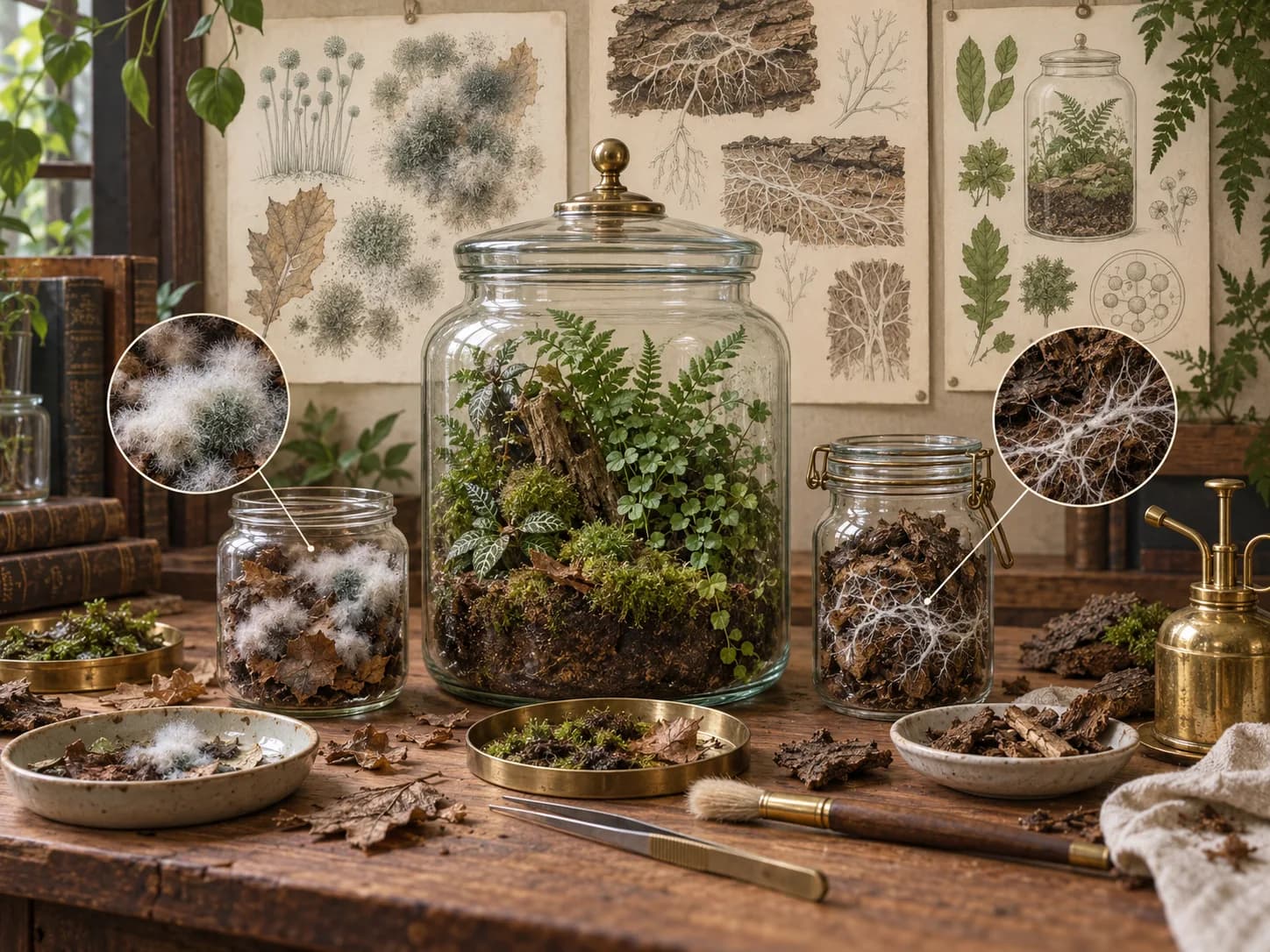
Those hand off to mould vs mycelium and troubleshooting. Do not rebuild on day two of fog.
Media (still)
Worry vs wait pair — opaque all-day fog with a wet mix (worry) beside light morning mist with firm plants (wait). Same caption style as the four-state set.
This jar, specifically
This page teaches the first closed jar: Closed Tropical Mix, Fittonia, cushion moss, and Pilea depressa. Springtails after cycling — not into a swamp.
Fittonia faints when dry and usually stands up after a drink; it also hates wet feet and cold draughts. In a sealed jar the drink is a pipette, not a thorough pot-watering.
Cushion moss wants a pearly surface, not a soak. Pale or yellow moss plus clear glass is a dry cue; brown plus harsh sun is light, not a need to flood.
Pilea depressa (tiny round glossy leaves on trailing stems — not Chinese money plant). Small pileas suit terrariums; overwatering is the usual fail. UK shops sometimes sell it as “baby tears.” That name also means Soleirolia. Use the scientific name on the label.
Springtails go in after cycling, when the weather is predictable and the mix is damp, not flooded. They do not fix a swamp.
Later warning — Soleirolia soleirolii: not in this trio. It smothers neighbours and wets the glass. Do not add it to a first jar.
Media (still)
Close-up of Pilea depressa leaves (round, glossy, trailing) next to a labelled card “Pilea depressa — not Soleirolia.” Optional third card if you have Soleirolia for the contrast, shot separately so nobody plants it.
Placement in a UK room
Bright shade, steady warmth, no radiator, no direct summer sun on the glass. Keep above about 15–17°C for Fittonia; unheated porches and between-curtain windowsills are winter traps. Bathrooms can work if there is enough light and the jar is not on a boiling towel rail. More on UK light and windowsills.
Media (still)
Three placements in one home — good (north/east sill or set back), bad heat (on a radiator or tight south glass), bad cold (between curtain and pane). Use the same jar. Caption each.
Science note
Condensation is the inside air hitting cooler glass. Night-time room drop makes morning mist; a heat spike makes rain. Still air against leaves keeps surfaces wet and helps fungi — a short vent stirs that air without turning the jar into an open bowl. Skip the numbers. Read the glass.
Troubleshooting
| Symptom | Checks | First steps | Escalate |
|---|---|---|---|
| Light mist that clears by afternoon | Mix still springy? Plants firm? | Do nothing. This is the cycle working. | Only act if plants wilt or moss goes pale. |
| Glass white all day; cannot see plants | Standing water in the false bottom? Mix soup-wet? Room cold or recently watered? | Lid off 2–6 hours. Wipe inner glass. Blot pools with kitchen paper. | If fog returns within days, siphon the reservoir and stay vented longer. Partial rebuild if the mix smells sour. |
| Droplets running like rain; jar warm | Direct sun through glass? Radiator, log burner, or telly heat? South window in summer? | Move to bright shade (north or east window, or set back from south/west). Never “dry it out” on a sunny sill. | Scorched Fittonia or cooked moss: trim dead tissue, keep the jar cooler, do not add water. |
| Fog only on one side | That side facing a window or a cold wall? | Rotate the jar weekly. Treat one-sided mist as weather, not a flood. | Persistent one-sided drip plus wet mix: vent as for all-day fog. |
| Clear glass for two or more days | Mix pale and shrunk from the glass? Moss dull or crispy? Fittonia floppy? Pilea depressa leaves thin and dull? | Pipette a few millilitres at the roots, or 2–3 light sprays. Reseal. Wait 24 hours. | Still dry: another small sip. Do not soak. Check the lid is actually sealing. |
| Pools in the LECA / false bottom | Can you see free water? Mix above still wet? | Siphon with a pipette or turkey baster. Do not tip the jar. Vent until the mix is damp, not glossy. | Recurring pools: drainage clogged or mix too dense — rebuild the false bottom. |
| White crust on glass, not fuzzy | Hard-water area? Wipes off easily? Not cottony? | Wipe. Switch to rain or filtered water. | If crust returns fast, stop tap water altogether. |
| Fittonia flat, mix dry, glass clear | Compost dry 1 cm down? Leaves soft, not mushy? | Small drink at the roots. It often stands up within the hour. | No recovery: treat as collapse in troubleshooting — likely rot, not thirst. |